
Which fishing line should you choose? Mono is a forgiving starting option, braid offers low stretch and a thin diameter for its strength, and fluorocarbon is often used as a sinking leader. Choose around your lure, cover and tackle. No line material is the best choice for every trip.
If your line basket contains three spools with similar strength labels and very different prices, pause before choosing the most expensive one. First decide whether you need a whole reel of main line or just the short section between that line and the lure.
Main line and leader do different jobs
Main line fills the reel. A leader is a separate section attached at its working end. With a braid main line, a suitable mono or fluorocarbon leader can provide a different material near the lure and structure. It also adds a knot that needs to be tied correctly. Daiwa explains the arrangement in its fishing-rod setup guide.
A quick comparison
| Material | Useful qualities | What to consider |
|---|---|---|
| Nylon monofilament | Generally affordable, manageable and forgiving under sudden load | Stretch reduces direct feel; diameter increases with strength |
| Braid | Low stretch and relatively small diameter at a given breaking strength | Less cushioning; connections and line management need attention |
| Fluorocarbon | Sinks and offers lower underwater visibility than braid | Can be stiff; sinking line can affect some surface presentations |
These are broad material differences, not a ranking of every spool. Berkley’s line guide and line-selection advice explain why the lure, water and cover change the decision.
Choose for the problem you have
“I want a simple first setup.”
Consider suitable mono if straightforward handling and a modest initial cost are priorities. Practise the connection you will actually use, and test it before fishing. You do not need to switch to braid just because another angler has it.
“I struggle to feel a small lure.”
Braid is worth considering, but check the full outfit first. A lure outside the rod’s useful casting range, a large bow of slack line or an unsuitable retrieve can all make control harder. Changing the spool alone may leave the original problem in place.
“My line keeps getting damaged near cover.”
Find where it is failing. Inspect the last section, the connection and the rod guides. A rough patch, a slipping knot and a clean cut suggest different things to investigate. Do not keep shortening damaged line indefinitely without finding the cause.
Do you always need a leader with braid?
No. The right connection depends on the technique. A leader is a useful option when you want a different material at the lure end; it is not an obligatory extra for every presentation. For a surface lure, test how the complete connection affects the lure at rest and during a pause.
Neither mono nor fluorocarbon should be treated as bite-proof. If fish with cutting teeth are the target, ask for a suitable bite-resistant trace. Avoid making that choice from a strength number alone.
Read more than the number on the front
- Breaking strength: a line rating is not a guaranteed fish weight you can lift.
- Diameter: compare this alongside strength and your reel’s capacity.
- Length: check whether the spool supplies enough main line or is intended for leaders.
- Material: a fluorocarbon-coated product is not the same description as 100% fluorocarbon.
- Selected variant: the product name may show one size while the selector offers several.
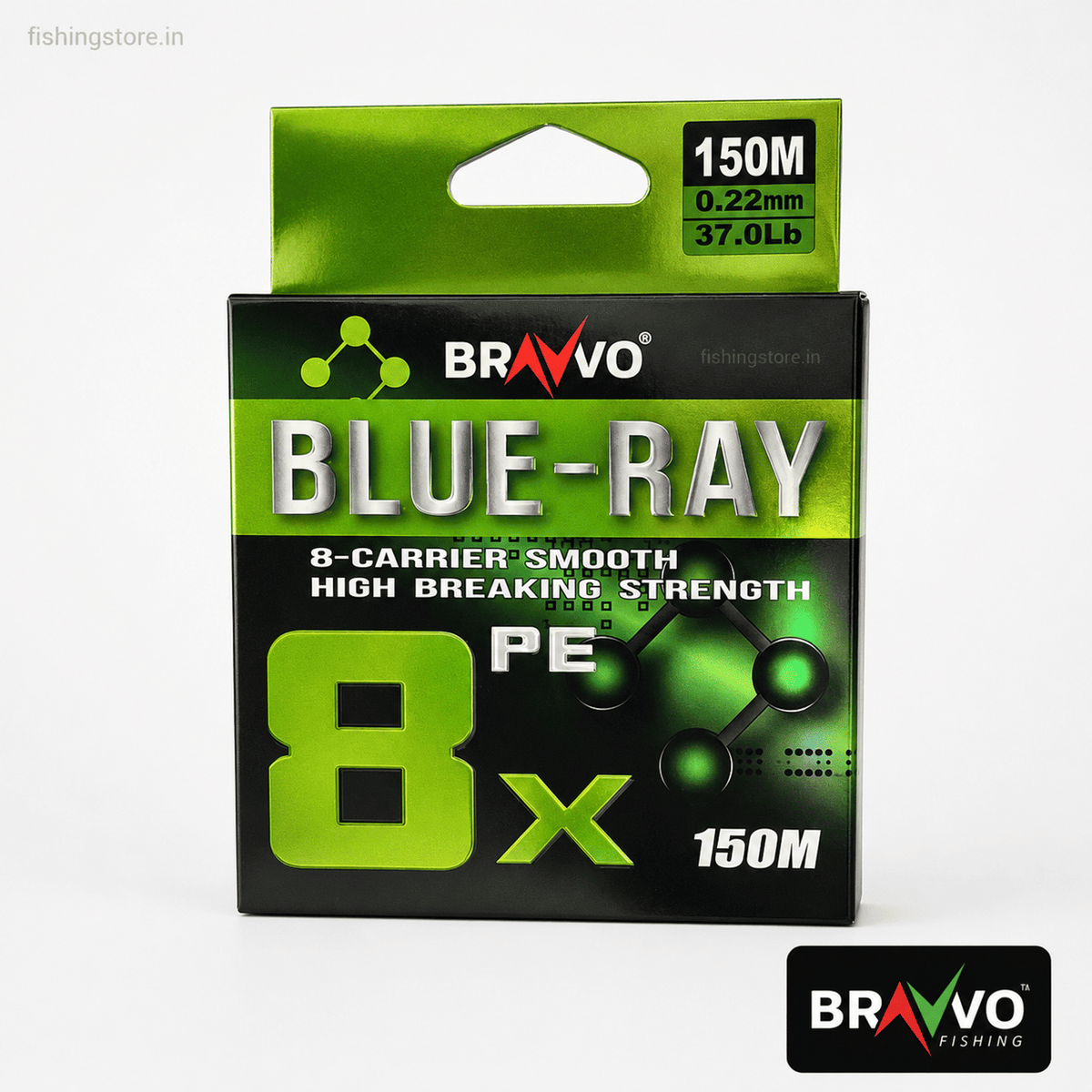
For example, our Bravvo Blue-Ray 150 m braid listing offers diameter variants. Select the required diameter and verify the matching strength information; do not infer a breaking strain from “8X” or the spool length.
Before your next cast
Check for abrasion and loose loops, make sure the line is following the guides correctly, and inspect the knot. Test connections with hooks secured and hands protected; never wrap braid around a bare hand to pull a snag free. Stop if a guide or connection is damaging the line.
Common questions
Does stronger line always cast better?
No. Strength is only one property. Diameter, reel filling, rod-and-lure compatibility and casting technique also matter.
Is fluorocarbon invisible?
Treat “invisible” as marketing shorthand, not a guarantee. Its lower visibility can be useful, but it does not remove the need for a suitable presentation.
Compare fishing lines and leaders, or return to the beginner tackle checklist to check the whole outfit before buying.
Ready to fish this setup?
Browse gear selected for Indian rivers, backwaters and coasts, or ask our team before ordering.


